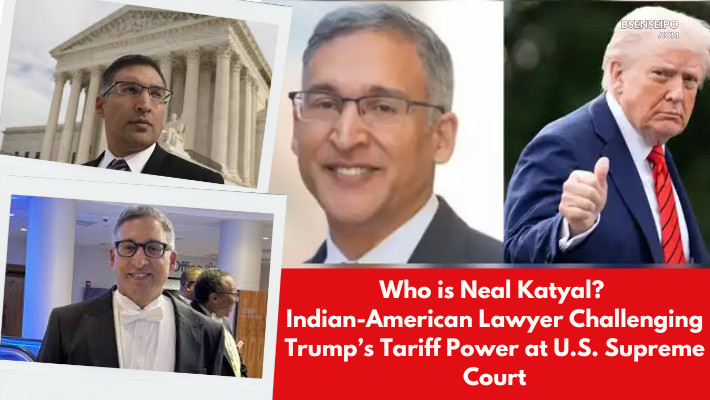
Who is Indian-Origin Lawyer Neal Katyal?
Neal Kumar Katyal is a highly prominent Indian-American lawyer, legal scholar, and former government official. He is recognized as one of the most experienced litigators before the U.S. Supreme Court.
Neal K. Katyal Profile
Neal K. Katyal is a prominent Indian-American constitutional lawyer, litigator and academic.
- Birth & Background: Born March 12, 1970 in Chicago, Illinois, to Indian immigrant parents — his mother, Pratibha, a paediatrician, and his father, Surendar, an engineer.
- Education: Undergraduate degree from Dartmouth College (BA) and Juris Doctor from Yale Law School (JD).

Key Career Highlights
- Former Acting Solicitor General of the United States: He served as the U.S. government’s chief advocate before the Supreme Court during the Obama administration (Acting S.G. from 2010 to 2011).
- Supreme Court Litigator: He has argued over 50 cases before the U.S. Supreme Court, holding the record for the most arguments by any minority attorney in U.S. history.
- Legal Scholar: He is the Paul and Patricia Saunders Professor of National Security Law at Georgetown University Law Center.
- Private Practice: He is a partner in the Litigation & Arbitration Group at the law firm Milbank LLP (previously Hogan Lovells), specializing in constitutional, national security, criminal defense, and appellate law.
- Landmark Cases: His work includes cases like successfully challenging the military tribunals at Guantanamo Bay (Hamdan v. Rumsfeld) and successfully defending the constitutionality of the Voting Rights Act of 1965.
- Pro Bono Work: He was part of the prosecution team that worked pro bono to hold Minneapolis police officers accountable for George Floyd’s death.
- Awards: He is the recipient of the Edmund Randolph Award, the highest civilian honor bestowed by the U.S. Department of Justice.
- Background: Katyal was born in Chicago to immigrant parents from India—his mother is a pediatrician and his late father was an engineer.
Indian-American Lawyer Taking on Trump’s Tariffs at the Supreme Court
Neal Katyal is the lead counsel in a high-profile case challenging the authority of the U.S. President to impose sweeping tariffs under a specific law.
US Tariffs – The Case
- Case Focus: The challenge centers on whether the President exceeded his authority under the 1977 International Emergency Economic Powers Act (IEEPA) to impose tariffs, which were enacted during President Trump’s administration.
- Katyal’s Argument: Katyal, representing small businesses and Democratic-led states, argues that the IEEPA never mentions tariffs and that the power of taxation and setting tariffs is reserved for Congress under the U.S. Constitution, not the President. He asserts that the President’s claim of authority under the IEEPA for such sweeping tariffs is unprecedented.
- Lower Court Victory: Katyal previously secured a significant 7-4 ruling in the Court of Appeals for the Federal Circuit, which found that the President had exceeded his authority. The current Supreme Court hearing is to determine if that lower-court decision stands.
- Significance: The case is considered one of the most important in American history, as its ruling will determine the limits of presidential power in foreign policy and trade, specifically the use of emergency powers for imposing tariffs.
The Tariff Case & Why It Matters
Katyal is leading a high-stakes legal challenge against the power of a U.S. President to impose sweeping tariffs under the 1977 International Emergency Economic Powers Act (IEEPA).
- The case concerns whether the President exceeded his authority when invoking IEEPA to impose tariffs without congressional approval.
- The lower court (U.S. Court of Appeals for the Federal Circuit) ruled 7–4 that the President had over-reached under IEEPA.
- The Supreme Court has consolidated the petitions (e.g., Learning Resources v. Trump) and is set to consider whether IEEPA authorizes tariffs and whether such delegation is constitutional.
- In a court filing, Katyal wrote: “The President’s claim of authority here is breathtaking. The IEEPA never mentions tariffs, and in 50 years, no other President has used it for that purpose.”
- The implications: If the Court agrees with Katyal’s side, it could significantly limit presidential authority over trade and tariffs, reaffirming congressional power in economic-policy domains.
Why His Role Is Noteworthy
- As an Indian-American from immigrant parents, Katyal embodies representation in high-level U.S. litigation and constitutional law.
- His career spans key landmark cases, including Hamdan v. Rumsfeld (Guantanamo detainee rights) and Moore v. Harper (election law).
- The tariff case places him again at the center of defining U.S. constitutional limits on executive power.