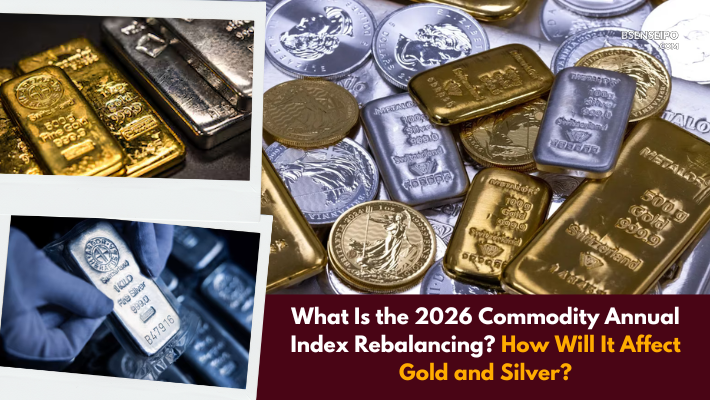
2026 Commodity Index Rebalancing: How Will It Affect Gold and Silver?
Commodity markets across the world witness a significant but often under-reported event every year — annual commodity index rebalancing. In 2026, this process is expected to once again influence prices, trading volumes, and investor sentiment, especially in precious metals like gold and silver.
The 2026 Commodity Annual Index Rebalancing is a mandatory, rules-based event where the world’s largest commodity benchmarks—the Bloomberg Commodity Index (BCOM) and the S&P GSCI—adjust their asset weightings.
Because gold and silver experienced a historic rally in 2025 (gold up ~65% and silver up ~150%), they have become “overweight” relative to index targets. This triggers a massive, price-insensitive “technical sell-off” by passive funds to bring these metals back in line.
Here’s a complete, easy-to-understand breakdown of what commodity annual index rebalancing means and how it could impact gold and silver in 2026.
What Is Commodity Annual Index Rebalancing?
Commodity Annual Index Rebalancing is the process by which major global commodity indices adjust the weightage of commodities within their index basket once every year.
Popular indices that undergo annual rebalancing include:
- Bloomberg Commodity Index (BCOM)
- S&P GSCI
- CRB Commodity Index
These indices are tracked by:
- ETFs
- Index funds
- Pension funds
- Institutional investors
When the index composition changes, funds tracking these indices must buy or sell commodities or futures contracts accordingly, leading to real market impact.
The Mechanics of the Rebalance
Indices like BCOM have strict rules: no single commodity can exceed 15% of the total index. After the “blistering” rallies of 2025, gold’s weight in BCOM climbed to over 20%. To follow the rules, index-tracking funds (managing over $100 billion) must sell their “excess” gold and silver futures starting January 8, 2026.
The Scale of the Selling
Analysts from JPMorgan and Citigroup estimate a combined outflow of roughly $11 billion to $13 billion from the precious metals sector during the five-day “roll period” (January 8–15).
-
Silver is most vulnerable, with expected selling representing nearly 9–12% of total open interest on the COMEX.
-
Gold faces a reduction in its target weight from 20.4% down to 14.9%, implying the sale of approximately 2.4 million troy ounces.
When Does the 2026 Rebalancing Happen?
While exact dates vary by index, commodity index rebalancing typically takes place in January 8–15, with:
- Weight changes announced in advance
- Actual fund adjustments occurring over a few trading sessions
The effects can be seen weeks before and after implementation due to anticipation and positioning by large traders.
How Are Commodity Weights Decided?
Commodity weight changes are based on:
- Liquidity and trading volume
- Production levels
- Price performance over the previous year
- Volatility controls (to prevent over-concentration)
Strong performers may see reduced weights, while underperformers or less volatile assets may gain weight.
Impact on Gold in 2026
Why Gold Matters in Index Rebalancing
Gold typically holds a significant weight in most commodity indices because of:
- High liquidity
- Global benchmark status
- Safe-haven demand
Possible Effects on Gold Prices
- If gold outperformed in 2025, its index weight may be trimmed to maintain balance
- This can lead to short-term selling pressure from index-tracking funds
- Conversely, if gold underperformed, it could see fresh inflows
Key Takeaway for Gold
- Short-term volatility around rebalancing
- No major long-term trend change unless supported by macro factors like interest rates, inflation, or geopolitics
Impact on Silver in 2026
Silver’s Dual Nature
Silver is both:
- A precious metal
- An industrial metal (used in EVs, solar panels, electronics)
How Rebalancing Can Affect Silver
- Silver often has lower index weight than gold, but changes can be more impactful
- If industrial demand weakened in 2025, silver weight may be reduced
- Any weight increase can trigger sharp inflows due to its smaller market size
Key Takeaway for Silver
- Higher volatility than gold
- More sensitive to index flows + industrial demand outlook
Short-Term vs Long-Term Impact
| Time Frame | Impact |
|---|---|
| Short Term | Price volatility, sudden spikes or dips |
| Medium Term | Stabilisation once rebalancing is absorbed |
| Long Term | Driven by macroeconomic factors, not index changes |
Why Investors Should Care
For:
- Gold & silver investors
- ETF holders
- Futures traders
Annual rebalancing can create:
- Temporary price dislocations
- Trading opportunities
- Misleading signals if fundamentals are ignored
Smart investors separate technical index-driven moves from real economic trends.
Final Thoughts
The 2026 Commodity Annual Index Rebalancing is not a fundamental shift but a mechanical adjustment that can:
- Influence gold and silver prices in the short term
- Increase volatility around January 2026
- Create entry or exit opportunities for informed investors
Gold is likely to remain stable with mild fluctuations, while silver could see sharper moves due to its smaller size and industrial sensitivity.
Key Stats & Timeline
| Metric | Gold Impact | Silver Impact |
| BCOM Weight Change | 20.4% → 14.9% | 9.6% → 3.9% |
| Estimated Selling Value | ~$6.8 Billion | ~$5.0 – $6.8 Billion |
| Open Interest Impact | ~3% of COMEX total | ~9 – 12% of COMEX total |
| Price Sensitivity | Est. 2.5% – 3% drag | High Volatility Expected |
Important Dates
-
January 8, 2026: Rebalancing window begins.
-
January 15, 2026: Rebalancing window concludes.
-
Late January: Market expected to return to fundamental-driven trading.