India Overtakes Japan to Become World’s 4th Largest Economy at $4.18 Trillion — Key Stats & Insights
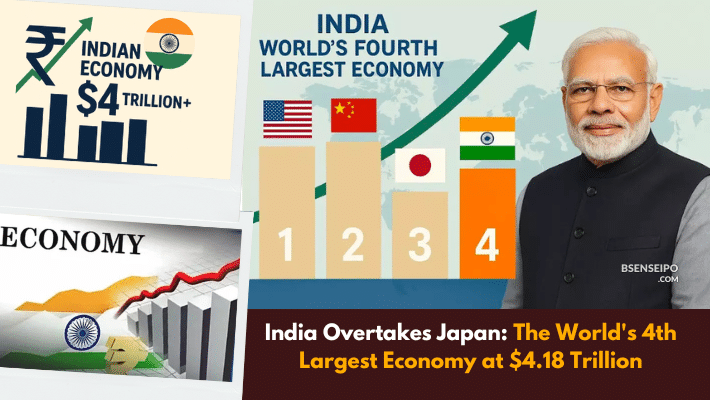
In a historic economic milestone, India has overtaken Japan to become the world’s 4th largest economy with a nominal **Gross Domestic Product (GDP) valued at approximately $4.18 trillion as of late 2025, according to the Indian government’s end-of-year economic review and international projections.
This achievement marks a watershed moment for India’s economic ascent — rising from being the eleventh-largest global economy just over a decade ago to now placing behind only the United States, China, and Germany.
How India Achieved This Milestone
Strong Growth Performance
India’s economy expanded at a robust clip — with real GDP growth reaching 8.2% in the second quarter of FY26 (2025-26), reflecting sustained demand and resilient expansion across sectors.
Domestic Consumption & Structural Reforms
A thriving domestic market, reforms to improve ease of doing business, infrastructure investments, digitisation, and demographic advantages played a key role in accelerating growth.
IMF & Global Forecasts
International agencies such as the International Monetary Fund (IMF) and the World Bank have consistently projected India’s growth prospects favourably, with India expected to further expand its GDP beyond the Japan figure — even under varied global economic conditions.
Japan’s Stagnating Growth
In contrast, Japan’s economy has seen relatively slower growth, which, coupled with currency valuation impacts, facilitated India surpassing Japan in nominal GDP rankings.
Current Nominal GDP Rankings (2025)
Based on the latest figures and official estimates:
| Rank | Country | Nominal GDP (Approx.) |
|---|---|---|
| 1 | United States | ~$30 trillion |
| 2 | China | ~$19 trillion |
| 3 | Germany | ~$5 trillion (projected) |
| 4 | India | ~$4.18 trillion |
| 5 | Japan | ~slightly below India |
| Sources: Government data & IMF projections |
India’s leap into the fourth spot marks a transition from emerging market status into a major global economic power.
India’s Journey — From $1 Trillion to $4 Trillion
The economic rise of India over the past two decades has been transformative:
Early 2000s: $1 Trillion Milestone (2007)
India crossed the $1 trillion GDP mark during the mid-2000s, boosted by liberalisation, services sector expansion, and investments in technology and services exports.
$2 Trillion Era (2014)
By the early 2010s, India’s economy had crossed roughly $2 trillion, driven by manufacturing growth, consumption, and a growing middle class. It took just 7 years to add the second trillion, as the services sector and IT exports surged.
$3 Trillion Growth (2019)
Between 2015 and the early 2020s, reforms such as the Goods and Services Tax (GST), digital adoption, and infrastructure spending helped push GDP toward the $3 trillion threshold. Reached in 5 years, showcasing India’s resilience despite global headwinds.
$4 Trillion and Beyond (2025)
By 2025, strong macroeconomic performance, demographic tailwinds, foreign investment, and a boom in sectors like services, tech, and manufacturing propelled India to the $4.18 trillion valuation — surpassing Japan in nominal GDP rankings. Despite the pandemic’s interruption, India added over $1 trillion in roughly 6 years, fueled by digital transformation and a manufacturing push (Make in India).
From $1 trillion to $4 trillion, India’s economy more than quadrupled in roughly two decades — a rare achievement among major economies.
Vital Stats: India vs. Japan (2025-26)
The shift in ranking is the result of India’s high-octane growth contrasting with Japan’s stagnant “lost decades” and a weakening Yen.
| Metric | India (2025-26) | Japan (2025-26) |
| Nominal GDP | $4.18 Trillion | ~$4.12 Trillion |
| Real GDP Growth | 8.2% (Q2 FY26) | ~0.8% – 1.0% |
| Inflation (CPI) | 0.71% (Nov 2025) | ~2.5% |
| Unemployment | 4.7% (Nov 2025) | ~2.6% |
| Global Rank | 4th | 5th |
Key Growth Drivers
-
Private Consumption: Robust demand in urban centers remains the backbone of the economy.
-
Digital Infrastructure: India’s UPI and “India Stack” have formalized the economy at an unprecedented scale.
-
Capital Expenditure: Massive government spending on railways, highways, and green energy.
-
Manufacturing Transition: The PLI (Production Linked Incentive) schemes have turned India into a global hub for electronics and iPhones.
The Road to $7.3 Trillion (2030)
The government has set its sights on Germany, currently the world’s third-largest economy. With a projected growth rate of 6.5% to 7% over the next few years, India is expected to displace Germany by 2028-2030, reaching a target GDP of $7.3 trillion.
The “Goldilocks” Phase: Economists describe India’s current state as a “Goldilocks” period—a rare combination of high growth and low inflation that provides the perfect environment for investment.
What This Means for India
Global Economic Influence
Achieving the fourth largest economy status elevates India’s global economic influence and enhances its position in international forums like the G20, IMF, World Bank, WTO and others.
Future Projections
India is projected to continue its upward trajectory. Governments and international institutions estimate that India could become the third-largest economy by as early as 2030 if growth momentum persists.
Challenges Ahead
While India’s aggregate GDP has grown impressively, GDP per capita remains lower compared to advanced economies, highlighting the importance of inclusive growth and job creation.
In a historic milestone for the global financial landscape, India has officially overtaken Japan to become the world’s 4th largest economy with a nominal GDP of $4.18 trillion. This achievement, confirmed by the Government of India in late December 2025, underscores a decade of rapid structural reforms and resilient domestic consumption.