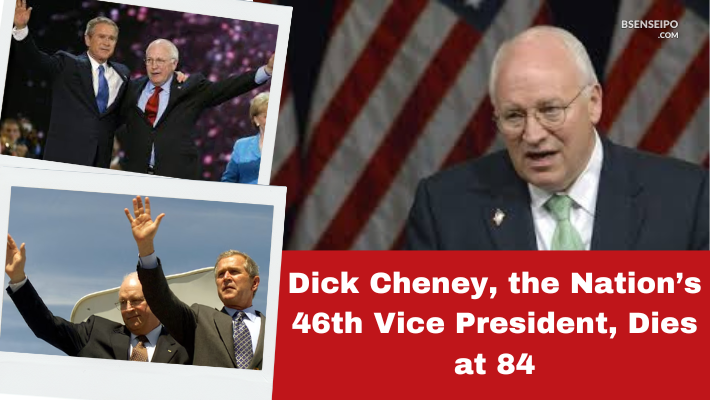
Dick Cheney, the Nation’s 46th Vice President, Dies at 84
Former U.S. Vice President Dick Cheney, a towering figure in American politics and one of the most powerful vice presidents in the nation’s history, passed away at the age of 84. According to his family’s statement, he died on Monday from complications of pneumonia and cardiac and vascular disease.
Cheney served as the 46th Vice President of the United States from 2001 to 2009 under President George W. Bush, during which time he wielded unprecedented influence for a vice president.
Before assuming the vice presidency, Cheney held multiple senior roles: White House Chief of Staff under President Gerald Ford, U.S. Representative for Wyoming, and U.S. Secretary of Defense under President George H. W. Bush — during which he oversaw the Gulf War.
Legacy of Service and Controversy
Cheney’s legacy is extremely consequential and also deeply polarising. On one hand, he is credited with strengthening American national security infrastructure, expanding the role of the executive branch, and playing a key part in the post-9/11 response, including the invasions of Afghanistan and Iraq.
On the other hand, his advocacy for expanded presidential powers, surveillance, and “enhanced interrogation” techniques have drawn significant criticism from human-rights observers and historians.
Health, Family & Final Years
Cheney had battled heart disease for decades, having survived multiple heart attacks and undergoing a heart transplant in 2012.
He is survived by his wife of 61 years, Lynne Cheney, and their two daughters, Liz Cheney and Mary Cheney. His family recalled him as “a great and good man who taught our children and grandchildren to love our country…” in the statement releasing the news of his death.
What This Means for U.S. Politics
With Cheney’s passing, the United States bids farewell to a central figure of the early 21st-century Republican establishment. His influence on foreign policy, national security and the role of the vice presidency will be studied for decades. Analysts will reflect on how the “Cheney era” molded governance post-9/11, shaped U.S. military engagements abroad, and left a complex legacy of security, power and controversy.
Former President George W. Bush remarked upon Cheney’s death: “History will remember him as among the finest public servants of his generation – a patriot who brought integrity, high intelligence and seriousness of purpose to every position he held.”
Final Word
As the nation and world reflect on Dick Cheney’s life and work, one thing is clear: few have held the office of vice president with as much influence and as many long-term consequences. His loss marks the end of an era in American politics, while his legacy will continue to spark debate and analysis.