
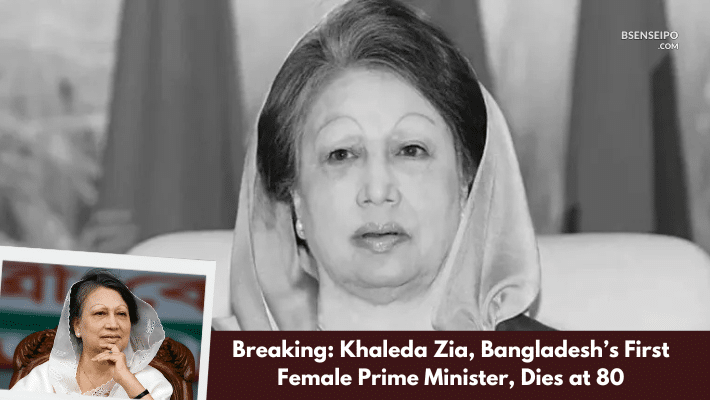
Bangladesh Mourns as Trailblazing Leader Khaleda Zia Dies at 80
Dhaka, Dec 30, 2025 — Begum Khaleda Zia, the first woman to serve as Prime Minister of Bangladesh and a towering figure in the nation’s modern political history, has died at the age of 80 after a prolonged illness, her party announced early Tuesday. Zia passed away at Evercare Hospital in Dhaka at around 6 a.m. local time, just after the Fajr prayer, leaving behind a deeply divided yet impactful legacy.
Zia, chairperson of the Bangladesh Nationalist Party (BNP), had been battling multiple serious health complications in recent weeks, including advanced cirrhosis of the liver, arthritis, diabetes, and chest and heart problems, according to her medical team. Her health had deteriorated rapidly after a lengthy hospital stay that began in late November.
A Pioneer in Politics
Born into modest circumstances, Khaleda Zia rose to national prominence following the assassination of her husband, President Ziaur Rahman, in 1981. She succeeded him as leader of the BNP in 1984, transforming the party into a formidable force in Bangladeshi politics.
In 1991, after years of political turmoil and military rule, Zia’s leadership helped usher in a democratic transition. She became the first woman prime minister of Bangladesh and only the second woman after Pakistan’s Benazir Bhutto to lead a democratically elected government in a predominantly Muslim nation. She served two terms: 1991–1996 and 2001–2006.
Her governments were known for moving Bangladesh from a presidential to a parliamentary system, expanding free and compulsory primary education, especially for girls, and reforming civil service entry rules.
Rivalry and Political Divide
Zia’s political life was deeply intertwined with that of her long-time rival, Sheikh Hasina, leader of the Awami League. Dubbed the “Battling Begums,” their rivalry defined Bangladeshi politics for decades, marked by bitter disputes, street violence, and allegations of vote rigging and political intimidation.
Her second term witnessed rising Islamist militancy and sharp economic challenges. Corruption cases later marred her reputation, and she spent several years in detention under Hasina’s government, which critics described as politically motivated maneuvers to weaken the opposition. In early 2025, however, she was acquitted of the last remaining corruption charges—a decision that had cleared the way for her brief return to political relevance before her health declined.
Final Days and Political Impact
Zia remained BNP chairperson until her death. In a symbolic move, party workers had filed nomination papers on her behalf for the upcoming February 2026 general election, underscoring her ongoing influence even in ill health. Her son, Tarique Rahman, returned from exile shortly before her death and is widely viewed as the heir to her political mantle.
Her passing comes at a critical moment in Bangladesh’s history, as the nation prepares for elections that could reshape the political landscape. Supporters across the country have begun commemorating her life, while rivals reflect on a career that was as controversial as it was historically significant.
Legacy and Reflection
Khaleda Zia’s legacy is multifaceted: a powerful female leader who broke barriers in Bangladeshi public life, a fierce political strategist and opposition figure, and one whose decades-long rivalry with Sheikh Hasina became emblematic of the nation’s political polarization. While opinions on her tenure remain sharply divided, her impact on Bangladesh’s democratic evolution is undeniable.
As the nation mourns, tributes pour in from all corners of society acknowledging her role in shaping modern Bangladesh—a complex figure whose political odyssey mirrored the aspirations and struggles of her country.