
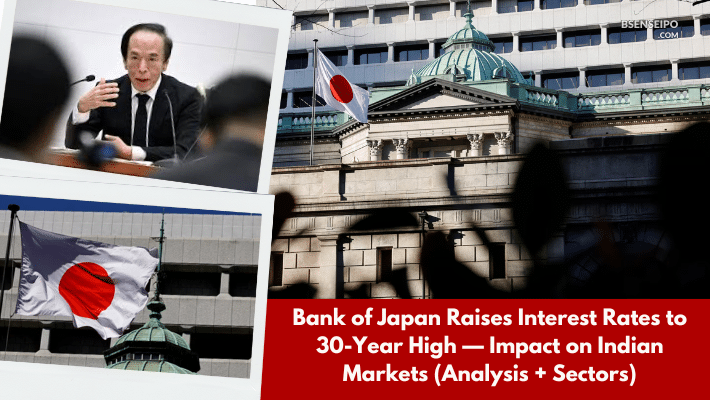
Bank of Japan Raises Rates to a 30-Year High
What Happened?
On 19 December 2025, the Bank of Japan (BoJ) raised its key short-term interest rate by 25 basis points to 0.75%, marking the highest level in roughly 30 years and a continued shift away from decades of ultra-loose monetary policy. This decision was widely anticipated by markets as inflation has remained above the BoJ’s target of ~2 %, bolstered by rising food costs and steady wage growth.
This increase comes after a series of earlier hikes (e.g., ending negative rates in 2024, moving up to 0.5%, etc.) and reflects Japan’s gradual normalisation of monetary policy after years of combating deflation with near-zero or negative rates.
The move also lifted Japanese 10-year government bond yields toward multi-year highs, while the yen weakened against the US dollar in early trading, illustrating complex market reactions.
When Did This Last Happen?
The last comparable level of interest rates in Japan goes back to the mid-1990s, with current policy rates now seen at levels not observed since around 1995 — roughly 30 years ago. For most of the intervening period, Japan kept rates very low or negative as part of an unprecedented fight against deflation.
Why It Matters Globally
This rate increase signifies a major milestone in Japan’s economic policy trajectory. Markets had largely priced in the hike, which helped avoid sudden volatility. However, BoJ tightening can influence global liquidity conditions, affect currency markets, and shift capital flows across borders — especially through mechanisms like the yen carry trade (borrowing in low-yield yen to invest in higher yielding assets abroad).
Impact on the Indian Stock Market
Although Japan is geographically distant from India, global financial markets are interconnected, and central bank actions in major economies can indirectly influence Indian equities and currency dynamics.
Foreign Institutional Investor (FII) Flows
- A tighter Bank of Japan BoJ policy can lead to shifts in global capital allocation, potentially reducing FII interest in emerging markets like India if global risk appetite contracts.
- However, because this hike was widely expected, immediate impact on FII flows may be muted.
Currency Movements: Rupee & Yen
- A rising Japanese rate might support the yen over time relative to the US dollar, but short-term reactions have seen a weaker yen as markets focus on other macro forces.
- If global risk sentiment shifts towards the dollar, the Indian rupee could weaken, affecting import costs and inflation dynamics in India.
Indian Equity Indices (Sensex & Nifty)
- Early reactions in Indian markets were positive or stable, with investors having largely priced in the event by the time of the decision.
- Domestic fundamentals — GDP growth, corporate earnings, RBI policy — remain key drivers for Indian stocks beyond global cues.
Sector-Wise Impact on Indian Markets
Sectors That May Benefit
IT and Export-Oriented Companies
- A weaker rupee (from global currency shifts) can boost revenue earnings in rupee terms for firms earning in USD or other foreign currencies (e.g., IT services).
- Export-oriented segments often benefit when global risk sentiment improves and domestic currency weakens moderately.
Certain Financials
- Banks and NBFCs might benefit if global monetary tightening signals stable inflation and orderly markets, though this is nuanced.
- Higher global yields can sometimes support interest income and asset repricing.
Sectors That May Face Pressure
Import-Intensive Sectors
- Oil and Gas / Aviation / Telecom: A weaker rupee makes imports more expensive, increasing input costs and squeezing margins.
- Imported inflation can also dampen consumer spending, indirectly affecting consumption-linked sectors.
Metals & Capital Goods (in certain conditions)
- If global risk aversion increases, these cyclical sectors may underperform as investors de-risk portfolios.
Domestic Interest-Rate Sensitive Sectors
- If global rate shifts eventually influence RBI policy (through inflation expectations), rate-sensitive sectors like real estate might face headwinds.
- However, RBI policy is primarily driven by domestic conditions rather than BoJ moves.
Broader Macroeconomic Effects
Exchange Rates & Inflation
- Global monetary tightening narratives — even outside India — can fuel dollar strength, pressuring the rupee.
- A weaker rupee tends to increase import bills (especially oil), pushing inflation, which might cause RBI to reassess monetary policy paces.
Volatility and Risk Sentiment
- Global central bank actions can heighten market volatility, though this particular BoJ hike was largely expected.
- Indian markets generally focus on domestic earnings fundamentals, meaning the long-term trajectory is less dependent on one external rate move.
Conclusion
The Bank of Japan’s 30-year high interest rate move on 19 December 2025 reflects a significant global monetary policy shift after decades of ultra-easy conditions. While the direct impact on the Indian stock market is limited — especially given that it was widely anticipated — it can still influence currency markets, foreign flows, and investor sentiment.
Beneficiaries in India may include IT and export-oriented firms, boosted by currency movements, while import-dependent sectors might face margin pressures if the rupee weakens. Overall, long-term Indian market direction remains tethered to domestic economic performance, RBI policy, and corporate earnings, even as global financial developments add nuance to investor strategies.