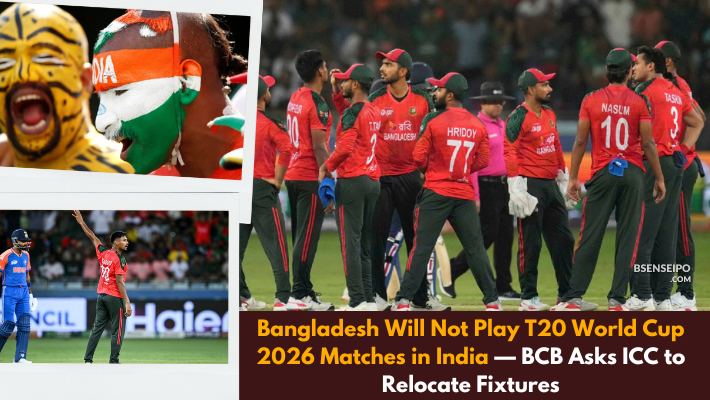
Bangladesh Will Not Play the T20 World Cup 2026 in India
In a major development that has sent shockwaves through international cricket, the Bangladesh men’s cricket team will not play its scheduled matches in India during the upcoming ICC Men’s T20 World Cup 2026. The Bangladesh Cricket Board (BCB) has confirmed that the team will not travel to India to take part in its World Cup fixtures, citing safety concerns, diplomatic tensions, and recent cricketing controversies as the primary reasons.
Originally scheduled to be jointly hosted by India and Sri Lanka from 7 February to 8 March 2026, the T20 World Cup’s group stage had Bangladesh lined up to play three matches in India — against West Indies, England, and Italy in Kolkata, followed by a game against Nepal in Mumbai.
However, that plan has now been thrown into uncertainty following a series of contentious events and public statements that have strained cricketing and diplomatic ties between the two neighbouring countries.
Why Bangladesh Has Taken This Decision
IPL Controversy and Mustafizur Rahman
The immediate catalyst for this decision was the controversial release of Bangladesh pacer Mustafizur Rahman from his Indian Premier League (IPL) 2026 side, Kolkata Knight Riders (KKR). The franchise confirmed that it had been instructed by the Board of Control for Cricket in India (BCCI) to remove Mustafizur from its squad — a move that sparked outrage among fans, players and officials back in Bangladesh.
Bangladesh’s Youth and Sports Adviser Asif Nazrul publicly linked this exclusion to broader political and communal tensions, asserting that if a Bangladeshi player could not safely play in India despite a valid contract, the entire national team could not be expected to feel safe travelling there for the World Cup.
Safety and Dignity Concerns
In an emergency meeting of its board directors, the Bangladesh Cricket Board decided not to send the team to India, citing security concerns for players and dignity for Bangladesh cricket. Officials have stated that they will make a formal appeal to the International Cricket Council (ICC), requesting that Bangladesh’s fixtures be relocated to Sri Lanka.
Sports adviser Nazrul described the decision as a stand against what he termed “extreme communal policy”, and reiterating that Bangladesh would not tolerate what it perceived as humiliation of its players and nation.
Diplomatic & Historical Context
The situation comes against a backdrop of heightened diplomatic tensions between India and Bangladesh in recent months, including political unrest back home in Bangladesh and controversial social incidents that have attracted media attention in both countries. These broader tensions have fed into the cricketing dispute, prompting national authorities to take unprecedented positions on a major ICC event.
The “Mustafizur Row” and Security Concerns
The primary catalyst for this withdrawal was the forced release of Bangladeshi pacer Mustafizur Rahman from the Kolkata Knight Riders (KKR). Following a directive from the BCCI, KKR terminated Mustafizur’s ₹9.20 crore contract citing “unresolved regional tensions.”
Key Reasons for the BCB’s Decision:
-
Player Safety: Bangladesh’s Sports Adviser, Asif Nazrul, stated that if a single contracted player like Mustafizur is not deemed safe in India, the government cannot guarantee the security of the entire national squad.
-
Diplomatic Tensions: Recent political shifts in Bangladesh and reports of communal friction have strained bilateral relations, leading to a “safety-first” approach by the interim government.
-
Dignity and Respect: The BCB characterized the BCCI’s directive to KKR as a “humiliation” to Bangladeshi cricket, leading to a complete refusal to travel to Indian venues.
Bangladesh’s World Cup Plans Now in Limbo
With Bangladesh declining to play in India, several questions now hang over the T20 World Cup schedule:
- Relocation Requests: BCB plans to formally request the ICC to move Bangladesh’s group fixtures from India to Sri Lanka, the tournament’s co-host.
- ICC Response: The ICC has not yet publicly responded to the request, and a final decision is expected once formal correspondence is received.
- Logistical Challenges: Moving fixtures late in the planning process would involve complex logistical changes — from ground bookings to travel, accommodation and broadcast commitments.
- Diplomatic Repercussions: This move marks a rare instance where geopolitical considerations are directly impacting the participation of a Full Member in a major ICC event.
If discussions with the ICC do not resolve the impasse, Bangladesh’s entire participation in the T20 World Cup could be jeopardised, potentially affecting the tournament’s competitive balance and global appeal.
Potential Scenarios and Cricket Impact
Several outcomes could unfold in the coming weeks:
- ICC Approves Relocation: Bangladesh’s matches may be shifted to Sri Lanka, allowing them to participate without travelling to India.
- Matches Stay in India: If the ICC rejects the request, Bangladesh may be faced with the choice of withdrawing from the tournament altogether.
- Diplomatic Resolution: A behind-the-scenes political solution could ease tensions and allow safe participation in Indian venues.
- Broader ICC Imperatives: The ICC may seek compromises to preserve the integrity of the tournament and protect commercial and global interests.
Regardless of the outcome, this episode underscores the increasing interplay between sports governance and international relations. It also highlights how cricket, deeply rooted in South Asian culture, can become entwined with national sentiment and political pressures.
What This Means for Fans and the Game
- Cricketing Rivalries: Bangladesh’s absence from matches in India could affect fans’ experience and rivalry matches with teams like England, West Indies and Nepal.
- Commercial Impact: Broadcasting, sponsorship and ticketing arrangements may need to be restructured if fixtures are relocated.
- Player Welfare: The episode raises questions about how cricket boards ensure player safety and engagement in politically sensitive environments.
Impact on the T20 World Cup 2026 Schedule
The tournament, co-hosted by India and Sri Lanka, is scheduled to run from February 7 to March 8, 2026. Bangladesh was originally slated to play three of its Group C matches (against West Indies, Italy, and England) at the Eden Gardens in Kolkata.
Proposed Solution: The “Hybrid Model”
The BCB has formally requested the International Cricket Council (ICC) to relocate all of Bangladesh’s matches to Sri Lanka.
| Current Scheduled Venue (India) | Opponent | Proposed Status |
| Kolkata | West Indies | Relocate to Colombo/Kandy |
| Kolkata | Italy | Relocate to Colombo/Kandy |
| Kolkata | England | Relocate to Colombo/Kandy |
| Mumbai | Nepal | Relocate to Colombo/Kandy |
Note: Similar to the arrangement made for Pakistan, who are already playing their matches exclusively in Sri Lanka, Bangladesh is now pushing for a complete “Hybrid Model” to avoid entering Indian territory.
Next Steps
The ICC will soon assess Bangladesh’s formal appeal. Meanwhile, cricketing and diplomatic stakeholders are expected to engage in discussions to prevent a historic standoff from undermining one of the sport’s marquee events.